EU Entry/Exit System and ETIAS: What Travellers Need to Know for 2027
Europe's borders changed more in the past year than in the previous decade. The passport stamp is gone at most Schengen crossings. In its place is the Entry/Exit System (EES), a database that scans your face and fingerprints and counts every day you spend in the zone, automatically.
A second change is on the way. ETIAS, the online travel authorisation for visa-free visitors, was supposed to arrive in the last quarter of 2026. It has slipped again and will not start before 2027.
This guide is for non-EU visitors planning trips in 2027, from British and American tourists to Schengen visa holders from Africa, South Asia and the Philippines. The rules differ for each group.
The short version: EES applies to almost every non-EU visitor on a short stay, visa or no visa. ETIAS will apply only to people who do not need a visa. If you need a Schengen visa, you will never need ETIAS.
In this guide
- What the Entry/Exit System actually does
- Where EES applies and where it doesn't
- What happens at the border on your first trip
- The 90/180 rule, now enforced by computer
- Who is not registered in EES
- ETIAS: what it is and when it starts
- ETIAS fee, validity and processing times
- ETIAS or a Schengen visa: which do you need?
- Watch out for fake ETIAS websites
- Queues: what to expect and how to cut your time
- Overstays and what your record means later
- Frequently Asked Questions
- Final Thoughts
What the Entry/Exit System actually does
EES is a shared register of every short-stay entry and exit by non-EU nationals across the participating countries. When you cross the external border, an officer or a self-service kiosk records your name, passport details, the date and place of entry, and your biometrics. When you leave, the exit is logged against the same record.
The point is arithmetic. Border guards used to work out your allowed stay from smudged ink stamps. Now the system does the sum and flags any overstay.
The rollout started on 12 October 2025 and was phased over six months. Countries could register only part of their traffic at first. That phase ended on 10 April 2026, when the system became fully operational across all participating states. A short window allowing partial suspensions at very busy crossings ran through the summer peak and has now closed, so at the time of writing (late 2026) every eligible traveller should be registered.
Where EES applies and where it doesn't
EES runs in 29 European countries: the 25 EU member states that apply Schengen rules at their external borders, plus Iceland, Liechtenstein, Norway and Switzerland. Bulgaria and Romania are included.
Two EU countries are out. Ireland is not in Schengen and keeps its own border checks. Cyprus is not yet fully in Schengen and does not use EES, although it will require ETIAS once that launches.
If you travel from the UK, you will meet EES before you leave British soil. France runs its border checks at Dover, the Eurotunnel terminal at Folkestone and Eurostar at London St Pancras, so registration happens there. Coach and car passengers at Dover have seen some of the longest waits for exactly this reason.
What happens at the border on your first trip
Your first crossing after EES started is the slow one. Expect the following:
- Your passport is scanned, either by an officer or at a kiosk.
- A facial image is taken.
- Four fingerprints are scanned (children under 12 are exempt from fingerprinting but still have a photo taken).
- You may be asked where you are staying, how long you are staying, and whether you have enough money and a return ticket.
- The officer confirms entry, and your record is created.
On later trips the system already holds your biometrics, so the check is usually a face match and a passport scan. Your record is kept for three years from your last exit. If you overstay, it is kept for five years.
Refusing to give biometrics means refusal of entry, and that refusal is recorded too.
Carry a return or onward ticket, proof of accommodation, and evidence that you can pay for your stay. Border guards have always been entitled to ask for these, and under EES they have more time to do it. Our guide to proof of funds for visa applications covers what counts as convincing evidence.
The 90/180 rule, now enforced by computer
Short-stay visitors can spend a maximum of 90 days in any rolling 180-day period across the whole Schengen area. It is not 90 days per country, and it is not 90 days per calendar year. On any given day, the border looks back 180 days and counts how many of those you spent inside the zone. If the total, including today, goes over 90, you are overstaying.
Both the day you arrive and the day you leave count as full days.
| Scenario | Days used | Can you enter? |
|---|---|---|
| 60 days in Spain in March and April, now arriving in June | 60 of last 180 | Yes, for up to 30 more days |
| 89 days in the zone in the past 180, arriving for a weekend | 89 + 3 | No, the third day would breach the limit |
| 90 days ending 1 March, returning 1 July | Days drop off as the window rolls | Partly; count carefully before booking |
| Long-stay visa or residence permit holder | Not counted under EES | Yes, under the permit's own rules |
Before EES, plenty of people "lost" a few days in the stamp chaos. That margin has gone. The European Commission publishes a free short-stay calculator through its visa policy pages; use it whenever you make back-to-back trips.
Who is not registered in EES
You are outside EES if you are:
- An EU, EEA or Swiss citizen.
- A non-EU national holding a residence permit or long-stay (D) visa from a Schengen country.
- A non-EU family member of an EU citizen who holds a residence card under EU free-movement rules.
- A UK national with a Withdrawal Agreement residence document from an EU country.
- A diplomat, crew member on duty, or a few other narrow categories.
Residents should carry the permit every time they cross.
ETIAS: what it is and when it starts
ETIAS (European Travel Information and Authorisation System) is a pre-travel online check for people who can visit Europe without a visa. You will fill in a form, answer security and health questions, pay the fee, and receive an authorisation linked to your passport. Airlines, ferry companies and coach operators will be required to check it before boarding.
It is Europe's version of the US ESTA or the UK Electronic Travel Authorisation.
ETIAS has been delayed several times, partly because it depends on EES working properly. The "last quarter of 2026" target was removed from the EU's travel portal in July 2026, and at the time of writing there is no new official date. The EU has promised several months' notice; industry estimates point to spring 2027 at the earliest. Any website quoting an exact launch date is guessing.
When it does start, the regulation provides for a soft landing: a transitional period of around six months when ETIAS is available but not strictly enforced, followed by a grace period of around six months during which first-time visitors without one can still be admitted once. Check the official ETIAS page before you book any trip in 2027.
ETIAS fee, validity and processing times
| Item | Detail |
|---|---|
| Fee | €20 (raised from the originally planned €7) |
| Who pays | Applicants aged 18 to 70 |
| Who doesn't pay | Under 18s and over 70s, though they still need an authorisation |
| Validity | 3 years, or until your passport expires, whichever comes first |
| Typical processing | Most decisions within minutes |
| Longer checks | Up to 4 days; up to 30 days if extra information or an interview is requested |
| Where it's valid | 30 countries: the 29 EES countries plus Cyprus |
The authorisation is tied to one passport. If you renew your passport, you need a new ETIAS. Approval does not guarantee entry; the border guard still decides.
ETIAS or a Schengen visa: which do you need?
This is where most of the confusion sits. ETIAS is only for nationalities that are already visa-exempt. It does not replace a visa for anyone.
| Your passport | What you will need from 2027 |
|---|---|
| UK, USA, Canada, Australia, New Zealand | ETIAS (once live) plus EES registration |
| UAE, Japan, South Korea, Singapore, Brazil, Mexico | ETIAS (once live) plus EES registration |
| India, Nigeria, Ghana, Pakistan, Bangladesh, Philippines | Schengen visa plus EES registration; no ETIAS |
| South Africa, Kenya, Egypt, Morocco, China | Schengen visa plus EES registration; no ETIAS |
| Any nationality with an EU residence permit | Neither for short trips within Schengen; not registered in EES |
The visa list changes from time to time, so check the EU's official list before applying. If you need a visa, our Schengen visa application guide walks through the fee, documents and which embassy to use.
Gulf residents: it is your passport that counts, not where you live. An Indian national living in Dubai still needs a Schengen visa.
Watch out for fake ETIAS websites
Plenty of sites already offer to "apply for ETIAS" for €50 or more. No application system exists yet, so any site taking payment now is taking your money for nothing. When ETIAS launches, use only the EU's europa.eu portal or the official app. EES registration is free.
Queues: what to expect and how to cut your time
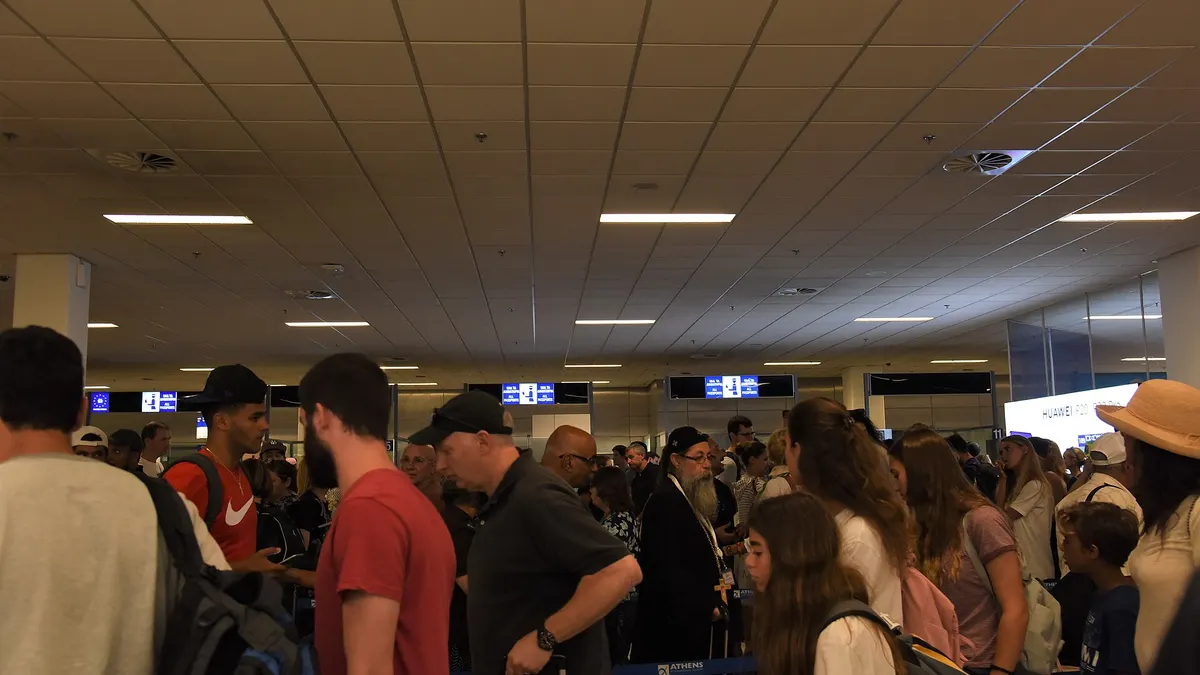
Full operation in April 2026 brought waits of up to two hours and missed flights at some major airports. Things improved as kiosks bedded in, but peak times remain slow, and the summer flexibility that let busy crossings suspend checks has ended.
Practical ways to save time:
- Allow an extra hour on your first trip since EES started, at both entry and exit.
- Use self-service kiosks where offered. They take your biometrics before you reach the officer.
- Check whether your departure point offers pre-registration. Some countries let you submit passport data and a photo in an official app before arrival. Uptake has been patchy.
- Avoid Saturday arrivals in July and August if you have any flexibility.
- Coach and car travellers at Dover should follow their operator's advice on arrival times; officers register everyone in the vehicle.
A flight missed because of a border queue is rarely the airline's problem, and only some travel insurance policies pay out, so read the "missed departure" clause of yours. Our guide to travel insurance for visa applications explains what to look for.
Overstays and what your record means later
An overstay of even a day or two is now visible to every Schengen country and to the consulates that process visas. Consequences range from a fine to an entry ban or a future visa refusal.
If illness or a cancelled flight strands you, contact the immigration authority where you are before your 90 days run out, and keep the evidence. A documented extension is very different from an unexplained overstay.
Frequently Asked Questions
Is the EES the same as ETIAS?
No. EES records your entries, exits and biometrics at the border and applies to nearly all non-EU short-stay visitors. ETIAS is an online authorisation you get before travelling, and it applies only to visa-exempt nationalities. Most British or American visitors will eventually deal with both.
When does ETIAS start?
There is no official date at the time of writing (late 2026). The EU removed its last-quarter-2026 target in July 2026 and says it will give several months' notice. Expect a launch some time in 2027, followed by transitional and grace periods before strict enforcement.
Do I need ETIAS if I already have a Schengen visa?
No. Visa holders never need ETIAS. You will still be registered in EES at the border, because EES covers visa holders and visa-exempt travellers alike.
Do UK citizens living in Spain or France need to register in EES?
Not if they hold a Withdrawal Agreement residence document or another residence permit from a Schengen country. Carry that card when travelling, because the border officer needs to see it to skip registration.
Does the 90/180 rule apply per country?
No, it applies to the whole Schengen area combined. A week in Italy, a month in Greece and two weeks in Germany all count towards the same 90 days in any 180-day window.
Final Thoughts
For most visitors EES is a one-off nuisance: a slow first crossing, then quicker trips. The real change is that the 90/180 rule is now policed by software. If you split your year between Europe and elsewhere, keep your own log of travel dates and check it against the official calculator before every trip.
For ETIAS, wait. Pay nothing until the EU announces a launch date, then apply only through the official portal or app. If you need a Schengen visa instead, start your appointment search early; consulate slots, not border queues, are still the bigger bottleneck for most of our readers.
This guide is general information based on official sources at the time of writing, not legal or financial advice. Immigration rules, fees and processing times change often, so check the official government website or speak to a licensed immigration adviser before you apply. Spotted something out of date? Tell us.